In a cash game, a chip is worth exactly its face value. In a tournament it isn't. Doubling your stack doesn't double your expected payout, and losing your stack costs more than the chips themselves. The Independent Chip Model, or ICM, puts numbers on that difference. Once you understand it, final-table and bubble decisions change completely.
Why Chips Lose Value as You Gain Them
Tournaments pay out a share of the prize pool to several finishers. First place doesn't take everything. So when you win chips, you gain less prize money than the chips suggest, and when you bust, you lose all your future payouts.
Consider an extreme case. Three players remain, and the payouts are 50%, 30% and 20%. Even a player with every chip but one can't win more than 50% of the pool, while just surviving guarantees 20%. Chips at the top are worth much less than chips near the bottom.
How ICM Calculates Equity
The standard model is called Malmuth-Harville. It assumes:
- Your chance of finishing first equals your share of the chips in play.
- Your chance of finishing second is worked out by removing each possible winner and repeating step 1 with the remaining players.
- And so on for each place.
Then you multiply each finishing chance by the payout for that place and add it up.
A Worked Example
Three players remain, with a $1,000 prize pool paying $500 / $300 / $200.
| Player | Chips | Chip share |
|---|---|---|
| A | 5,000 | 50% |
| B | 3,000 | 30% |
| C | 2,000 | 20% |
Chance of finishing first is just the chip share: A 50%, B 30%, C 20%.
Chance of finishing second, for Player A:
- If B wins (30%), A has 5,000 of the remaining 7,000 chips: 0.30 × 5/7 = 21.4%
- If C wins (20%), A has 5,000 of 8,000: 0.20 × 5/8 = 12.5%
- Total = 33.9%
The same method gives B 37.5% and C 28.6%. Third place takes what's left.
| Player | 1st | 2nd | 3rd | ICM equity | Share of pool | Share of chips |
|---|---|---|---|---|---|---|
| A | 50.0% | 33.9% | 16.1% | $383.93 | 38.4% | 50% |
| B | 30.0% | 37.5% | 32.5% | $327.50 | 32.8% | 30% |
| C | 20.0% | 28.6% | 51.4% | $288.57 | 28.9% | 20% |
The chip leader holds half the chips but only 38% of the money. The short stack holds a fifth of the chips but nearly 29% of the money. ICM moves value from big stacks to small ones.
Risk Premium: Why Calling Gets Harder
In chip terms, calling an all-in for even stakes needs 50% equity, ignoring blinds and antes. Under ICM you need more, because the money you'd lose by busting outweighs what you'd gain by winning. That gap is called the risk premium.
Player B Calls Player C's All-In
C moves all-in for 2,000. B is deciding whether to call.
- If B wins: C is out with $200. A and B each have 5,000, so they're even heads-up for the remaining $800 at $500/$300. B's equity is $400.
- If B loses: stacks become A 5,000, B 1,000, C 4,000. Running ICM gives B $246.67.
B's equity before the decision is $327.50.
| Outcome | B's equity | Change |
|---|---|---|
| Win | $400.00 | +$72.50 |
| Lose | $246.67 | −$80.83 |
B needs to win often enough for the gains to cover the losses:
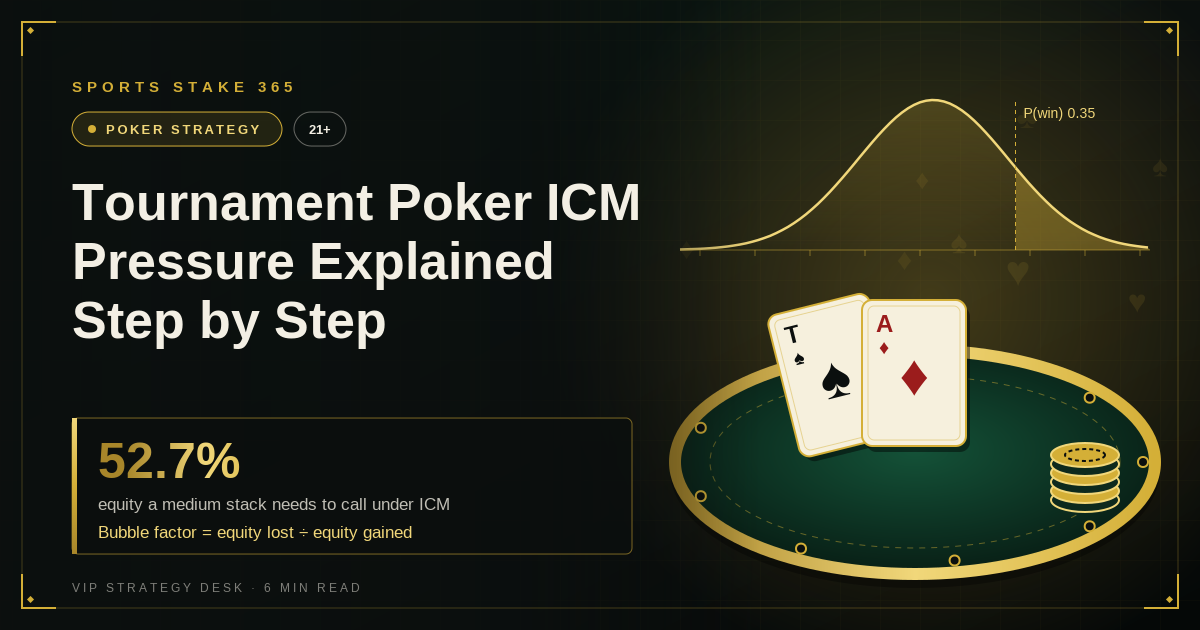
e × 400 + (1 − e) × 246.67 = 327.50, so e = 52.7%
B needs 52.7% equity instead of 50%. The risk premium is 2.7 points.
Player A Calls Player C's All-In
- If A wins: A 7,000 and B 3,000 heads-up. A's equity is 0.7 × $500 + 0.3 × $300 = $440.
- If A loses: stacks become A 3,000, B 3,000, C 4,000. ICM gives A $322.86.
e × 440 + (1 − e) × 322.86 = 383.93, so e = 52.1%
Even the chip leader pays a premium, though a smaller one, because A can lose without busting.
| Caller | Required equity (chip EV) | Required equity (ICM) | Risk premium |
|---|---|---|---|
| A (big stack) | 50.0% | 52.1% | 2.1% |
| B (medium stack) | 50.0% | 52.7% | 2.7% |
These premiums look small at three-handed with this payout structure. On a real bubble, where the next elimination is worth a lot more, risk premiums of 10 to 20 points are common for medium stacks. A hand that's an easy call in chips becomes a clear fold.
The Bubble Factor
Another way to express the same idea is the bubble factor: the ratio of what you lose by losing to what you gain by winning.
Bubble factor = equity lost ÷ equity gained
For Player B above, it's 80.83 ÷ 72.50 ≈ 1.11. Above 1, you need more than chip-EV equity to call. On a money bubble, medium stacks often face bubble factors of 1.5 or more.
Applying ICM Pressure From a Big Stack
ICM hurts players calling all-ins, and that gives the chip leader leverage.
- Open wider against medium stacks. They face the biggest risk premium, since they can bust but aren't desperate. They'll fold hands they'd normally defend.
- Be careful attacking the short stack. Short stacks have less to lose and more to gain, so they call and shove wider.
- Avoid confrontations with the other big stack. When two big stacks clash, both risk dropping down the payouts while the short stacks move up for free.
- Use the bubble. Just before the money, many players tighten up sharply. That's when wide raising gains the most.
Playing Under ICM Pressure
When you're the medium stack facing aggression:
- Tighten your calling range, not necessarily your shoving range. Shoving first gives you fold equity, while calling doesn't.
- Watch the shorter stacks. If another player is about to blind out, folding into a pay jump can be worth more than a coin flip.
- Don't over-correct. ICM pressure is real, but folding everything gives the big stack free chips. You still need to take some risks to give yourself a chance at first place.
Limits of the Model
ICM ignores skill, position and future blinds. A strong player with a short stack is worth more than ICM says, and a weak player with a big stack is worth less. Modern tools adjust for this with future-game simulation. But for decisions at the table, plain ICM gets you most of the way.
Key Takeaways
- Tournament chips lose value as your stack grows.
- Calling all-ins needs more than 50% equity when payouts are at stake.
- Medium stacks feel the most ICM pressure.
- Big stacks should use that pressure by opening wide.
- Run ICM spots in a calculator after each session to train your instincts.
Chips are only a means of getting paid. ICM is how you keep that in mind.