Every call in poker is a price. You put in a set amount for a chance at the pot. Pot odds tell you whether that price is fair today. Implied odds tell you whether it's fair once you count the money you could win later. Get comfortable with both and many hard decisions become simple arithmetic.
Pot Odds: The Core Formula
Pot odds compare the size of your call with the size of the pot you'd win. The cleanest way to use them is to turn them into required equity: the share of the time you must win for the call to break even.
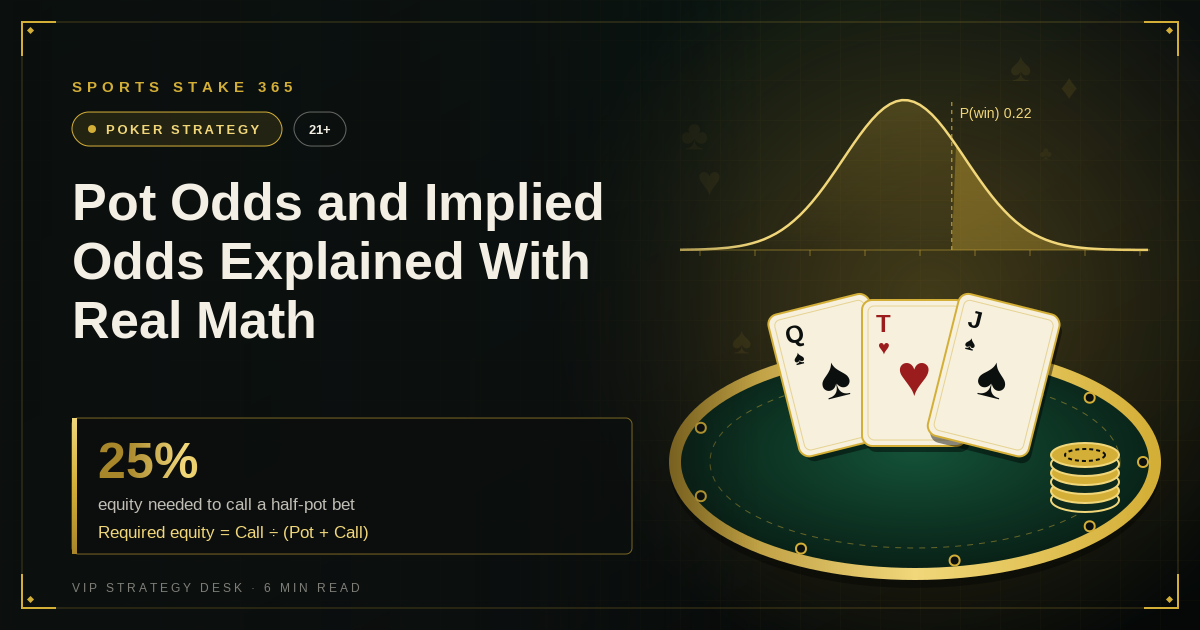
Required equity = Call ÷ (Pot after your call)
Say the pot is $100 and your opponent bets $50. The pot is now $150, you must call $50, and after your call it'll be $200.
Required equity = 50 ÷ 200 = 25%.
If your hand wins more than 25% of the time, calling makes money in the long run. If it wins less, calling loses money.
Required Equity by Bet Size
Bet sizes repeat, so it helps to memorize what each one asks of you.
| Opponent's bet (fraction of pot) | You need to win | Odds against |
|---|---|---|
| 1/4 pot | 16.7% | 5 to 1 |
| 1/3 pot | 20.0% | 4 to 1 |
| 1/2 pot | 25.0% | 3 to 1 |
| 2/3 pot | 28.6% | 2.5 to 1 |
| 3/4 pot | 30.0% | 2.33 to 1 |
| Pot | 33.3% | 2 to 1 |
| 2x pot (overbet) | 40.0% | 1.5 to 1 |
Note how slowly the required equity rises. Going from a half-pot bet to a full-pot bet doubles the bet but only moves the required equity from 25% to 33%.
Counting Outs
Outs are the unseen cards that improve you to the likely best hand. After the flop there are 47 unseen cards from your point of view: 52 minus your two and the three on the board. After the turn there are 46.
Here are the exact chances of hitting:
| Draw | Outs | Flop → Turn | Turn → River | Flop → River (two cards) |
|---|---|---|---|---|
| Pocket pair to set | 2 | 4.3% | 4.3% | 8.4% |
| Gutshot straight | 4 | 8.5% | 8.7% | 16.5% |
| Two overcards | 6 | 12.8% | 13.0% | 24.1% |
| Open-ended straight | 8 | 17.0% | 17.4% | 31.5% |
| Flush draw | 9 | 19.1% | 19.6% | 35.0% |
| Flush + gutshot | 12 | 25.5% | 26.1% | 45.0% |
| Flush + open-ender | 15 | 31.9% | 32.6% | 54.1% |
The two-card column uses 1 − (misses ÷ 47) × (misses ÷ 46). For a flush draw that's 1 − (38/47 × 37/46) = 35.0%.
The Rule of 2 and 4
At the table, multiply your outs by 2 for one card to come, or by 4 for two cards to come. A flush draw on the flop is about 9 × 4 = 36%, close to the true 35%. The shortcut overstates big draws, so for 15 outs use (outs × 4) − (outs − 8), which gives 53%.
Only use the two-card number if you'll actually see both cards. If your opponent can bet again on the turn, price the call one card at a time.
Discounting Dirty Outs
Not every out is clean. If you hold J♥T♥ on K♥7♥2♣ against a likely set, the 7♦ and 2♦ don't help you even though they look harmless, and a heart that pairs the board can give your opponent a full house.
A quick discount method:
- If an out also gives your opponent a better hand, drop it.
- If an out only sometimes wins, such as an overcard against an unknown pair, count it as half.
- Against tight, strong ranges, assume one or two of your outs are dirty.
Two overcards are rarely worth the full six outs. Against an overpair they're worth zero.
Implied Odds: Pricing Future Money
Pot odds only count the money already in the pot. Implied odds count what you expect to win on later streets when you hit.
Use the break-even formula. Let P be the pot including the opponent's bet, C your call, e your chance to hit, and X the extra money you expect to win when you do:
e × (P + X) ≥ (1 − e) × C, so X ≥ ((1 − e) × C ÷ e) − P
Worked Example
You hold a flush draw on the turn. The pot was $100 and your opponent bets $100. P = $200, C = $100, and with 9 outs e = 9/46 = 19.6%.
Pot odds alone require 33.3%. You're well short.
How much more do you need to win on the river?
X ≥ (0.804 × 100 ÷ 0.196) − 200 ≈ 410 − 200 = $211
If you can expect to win about $211 more on the river when your flush comes in, the call breaks even. If your opponent has $80 left behind, it's a clear fold. If they have $600 and pay off river bets often, it's a call.
What Makes Implied Odds Good or Bad
| Better implied odds | Worse implied odds |
|---|---|
| Deep stacks behind | Short stacks |
| Hidden draws, like gutshots and sets | Obvious draws, like a third suited card |
| Opponents who hate folding | Tight players who fold to scare cards |
| You're in position | You're out of position |
| Your draw is to the nuts | Your draw can make a second-best hand |
Reverse implied odds are the opposite. They're the money you lose when you hit a hand that's still second-best. Low flush draws and the low end of straights carry the most risk. A 6-high flush on a four-flush board can cost you a stack.
Set Mining: The Classic Implied Odds Spot
Calling a preflop raise with a small pair hoping to flop a set is pure implied odds. You flop a set or better about 11.8% of the time, roughly 1 in 8.5.
A common rule of thumb is that you want effective stacks of at least 15 to 20 times the call. If you call a $6 raise with 44, you'd like about $90 to $120 behind, and an opponent who'll actually put it in. In practice you won't always get paid, so deeper stacks are better.
Putting Pot Odds Into Practice
- Turn the bet into required equity using the table above.
- Count clean outs and convert them into a percentage.
- If equity is higher than required equity, call.
- If it's short, ask whether implied odds cover the gap. Use the formula, then sanity-check against stack depth and opponent type.
- Don't forget fold equity. If raising could win the pot right now, a semi-bluff can beat both calling and folding.
None of this needs a calculator. With a few hundred hands of practice you'll be doing the math faster than the time bank runs out.