Ask ten winning Hold'em players what they'd keep if they could keep only one edge. Most will say position. Hand selection matters. Hand reading matters. But acting last on every street pays you in every hand you play, while other skills only pay off in certain spots.
This guide covers why position is worth so much, how it should change your opening ranges, and what to do differently when you have it and when you don't.
What "Position" Actually Means
Position is the order you act in after the flop. The dealer button acts last on the flop, turn and river. The small blind acts first. Before the flop, the order is a little different because the blinds act last, but they give that back for the rest of the hand.
At a six-handed table the seats are:
| Seat | Abbreviation | Postflop order (vs. the field) |
|---|---|---|
| Under the Gun | UTG | Early |
| Hijack | HJ | Middle |
| Cutoff | CO | Late |
| Button | BTN | Last |
| Small Blind | SB | First |
| Big Blind | BB | Second |
At nine-handed tables you add UTG+1, UTG+2 and the Lojack in front of the Hijack. The principle is the same: the closer you sit to the button, the more information you'll have when you decide.
Why Acting Last Is Worth So Much
Acting last gives you three concrete advantages.
- Information. You see what your opponent does before you decide. A check often means weakness. A bet tells you something too. Your opponent has to decide without that information.
- Pot control. In position you can check behind to see a free card or keep the pot small with a medium hand. Out of position, if you check, your opponent decides whether the pot grows.
- Realizing equity. A hand's raw equity is its chance to win at showdown. In position you get to showdown more often with the equity you have. Out of position you get bet off hands more often. Solver studies consistently find that hands realize more than their raw equity in position and noticeably less out of position.
The results show up clearly in any large hand history database. For almost every winning player, the button is the most profitable seat, the cutoff is second, and the blinds lose money. Losing in the blinds is normal, because you paid in before seeing a card. The goal there is to lose as little as possible.
The Math of Players Left to Act
One reason early-position ranges are tight is simple arithmetic. The more players left to act behind you, the more likely one of them holds a hand that dominates yours.
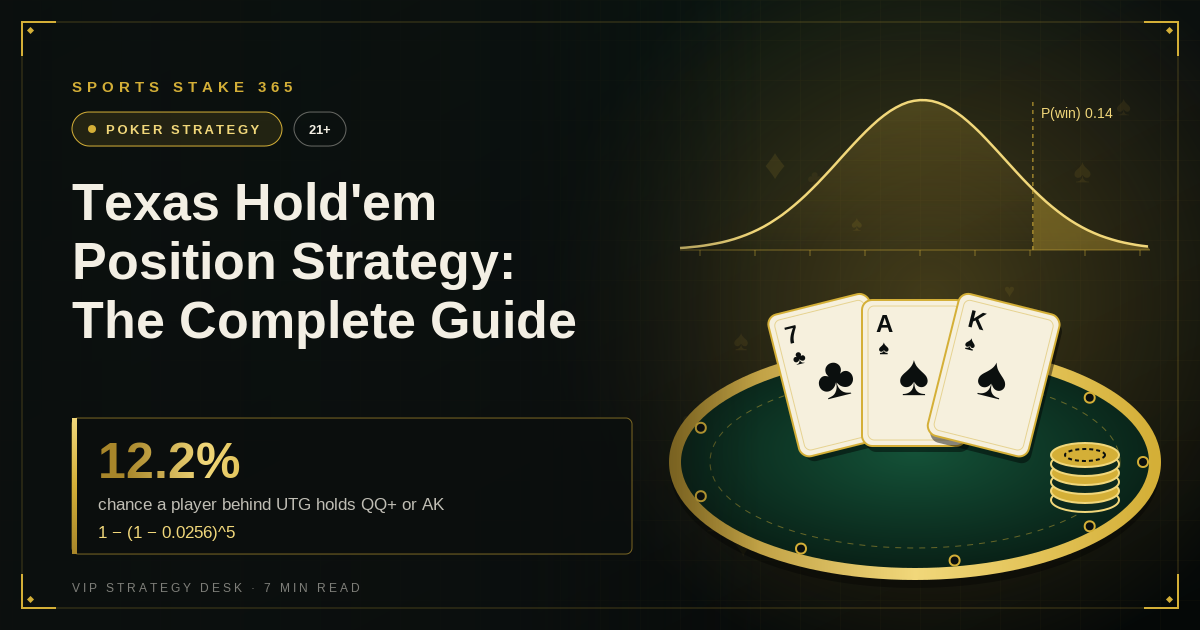
Take the premium group of AA, KK, QQ and AK. That's 6 + 6 + 6 + 16 = 34 combinations out of 1,326, or about 2.56% for any single opponent. Treating opponents as roughly independent:
| Players left to act | Chance at least one has QQ+/AK |
|---|---|
| 1 (SB vs. BB) | 2.6% |
| 2 (BTN) | 5.1% |
| 3 (CO) | 7.5% |
| 4 (HJ) | 9.9% |
| 5 (UTG, 6-max) | 12.2% |
| 8 (UTG, 9-max) | 18.7% |
A hand like KJ offsuit looks fine on the button. From UTG at a full table, nearly one time in five someone behind you has a premium hand that crushes it, and you'll play the rest of the hand out of position against several players.
Opening Ranges by Position
The ranges below are a sensible baseline for a 100-big-blind, six-handed cash game where the action folds to you. They're rounded, simplified versions of what modern solvers suggest. Treat them as a starting point, not a script.
| Position | Approx. % of hands | Example range |
|---|---|---|
| UTG | 15–17% | 22+, A2s+, KTs+, QTs+, JTs, T9s, AJo+, KQo |
| HJ | 19–21% | 22+, A2s+, K9s+, Q9s+, J9s+, T9s, 98s, ATo+, KJo+ |
| CO | 26–29% | 22+, A2s+, K6s+, Q8s+, J8s+, T8s+, 97s+, 87s, 76s, A8o+, KTo+, QTo+, JTo |
| BTN | 42–48% | 22+, any suited ace, most suited kings, Q5s+, J7s+, suited connectors, A2o+, K8o+, Q9o+, J9o+, T9o |
| SB (raise or fold) | 35–45% | Similar to BTN, slightly tighter on offsuit hands |
Two patterns matter more than the exact cells.
- Suited and connected hands gain value in position. Hands like 87s make straights and flushes that win big pots, and in position you can play them cheaply and get paid when they hit.
- Offsuit broadway hands lose value out of position. KJo and QJo make lots of second-best pairs. Those hands are expensive to play from early seats because you keep facing bets with no information.
Playing In Position
When you have position, your job is to use it.
Bet for thin value more often. On the river, in position, you can bet medium-strength hands knowing your opponent has already checked and capped their range. Out of position, the same bet runs into check-raises.
Float more flops. Calling a flop continuation bet in position with a backdoor draw or overcards works because you can take the pot away on the turn when your opponent checks. That play loses most of its value out of position.
Take free cards. With a draw on the turn, checking behind gives you a free look at the river. It's a quiet edge, but it adds up over thousands of hands.
Steal blinds aggressively. On the button, the blinds will fold a large share of their hands to a standard raise. If they fold more than about 40% of the time to a 2.5-big-blind open, many marginal hands become profitable opens on the fold equity alone.
Playing Out of Position
You will play a lot of hands out of position, mostly from the blinds. A few principles help.
- Defend the big blind with a plan. Against a button open you're getting a good price, so you should defend wide. But defend with hands that play well postflop: suited cards, connected cards and pairs. Dropping weak offsuit hands like J4o costs you very little.
- Check-raise as a weapon. Since you can't use position, you need moves that punish opponents who bet too often. A balanced check-raise range, with strong made hands and good draws, does that.
- Keep pots small with medium hands. Don't build a big pot out of position with one pair and a weak kicker. Check-call or check-fold and avoid reopening the betting.
- 3-bet more, call less from the small blind. Calling from the small blind invites the big blind to squeeze, and you'll play the whole hand first to act. A raise-or-fold strategy from the SB is simpler and usually stronger.
Common Position Mistakes
| Mistake | Why it costs you | Fix |
|---|---|---|
| Playing the same range from every seat | Weak early-seat hands run into dominating holdings | Tighten UTG, widen from CO and BTN |
| Cold-calling 3-bets out of position | Big pot, no initiative, no information | 4-bet or fold more often |
| Never checking behind in position | Bloats pots with medium hands and loses free cards | Check back marginal hands on the turn |
| Over-defending the small blind | Sandwiched by the BB and out of position all hand | Use raise-or-fold from the SB |
Putting It Together
Position doesn't win a single hand by itself. It makes every other skill you have work better. Your reads are more accurate because you see more actions. Your value bets are thinner and safer. Your bluffs are better timed.
A practical exercise: filter your last 10,000 hands by position and compare win rates. If your button isn't your best seat by a wide margin, you're probably not opening wide enough or not using position after the flop. If your early-position win rate is negative, tighten up. That review often finds more profit than any new trick.