Roulette looks like a game with dozens of different bets. Mathematically it's almost one bet, priced the same way across the whole layout. The only real choice that changes your long-run cost is which wheel you sit at. This guide shows why.
The Two Wheels
- European (single-zero): 37 pockets, numbers 1 to 36 plus a single 0.
- American (double-zero): 38 pockets, numbers 1 to 36 plus 0 and 00.
The payouts are the same on both wheels. A straight-up bet on one number pays 35 to 1 either way. That's the key to the house edge. The casino pays as if there were 36 pockets, while the wheel has 37 or 38.
Where the House Edge Comes From
Take a $1 straight-up bet on a single number.
European wheel:
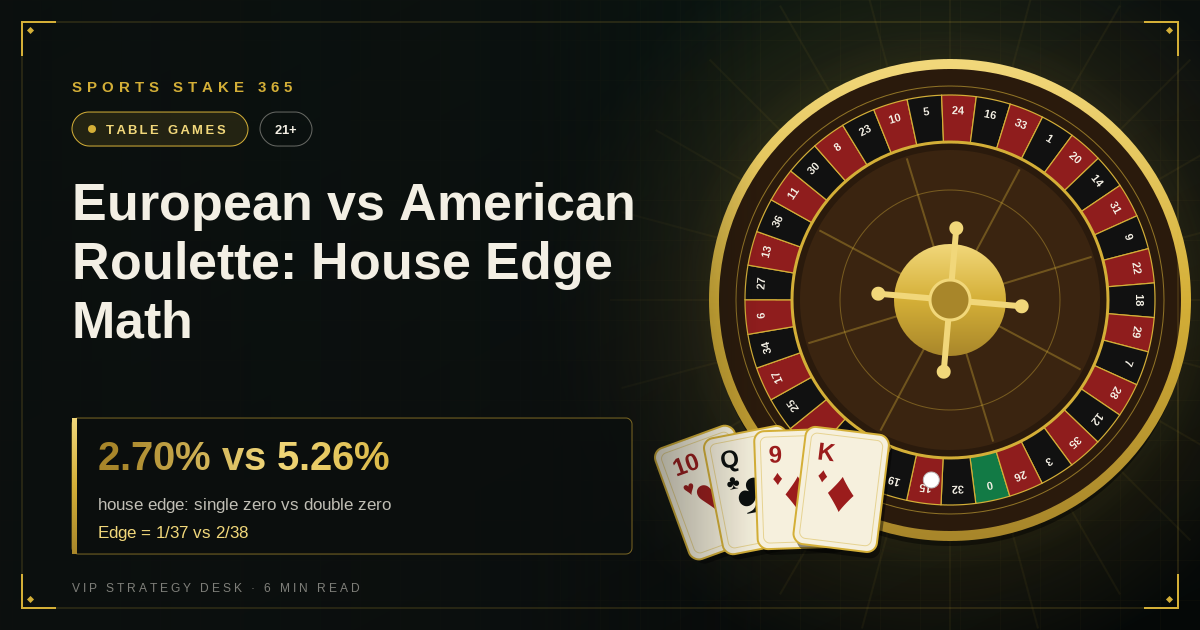
EV = (1/37 × $35) − (36/37 × $1) = −$1/37 = −2.70%
American wheel:
EV = (1/38 × $35) − (37/38 × $1) = −$2/38 = −5.26%
The European edge is 1/37. The American edge is 2/38. One extra green pocket nearly doubles what you pay.
Every Bet Costs the Same
Here's the full layout of standard bets. Notice that the house edge doesn't change across them on either wheel, with one exception.
| Bet | Covers | Payout | Win chance (Europe) | Win chance (USA) | Edge (Europe) | Edge (USA) |
|---|---|---|---|---|---|---|
| Straight up | 1 | 35:1 | 2.70% | 2.63% | 2.70% | 5.26% |
| Split | 2 | 17:1 | 5.41% | 5.26% | 2.70% | 5.26% |
| Street | 3 | 11:1 | 8.11% | 7.89% | 2.70% | 5.26% |
| Corner | 4 | 8:1 | 10.81% | 10.53% | 2.70% | 5.26% |
| Six line | 6 | 5:1 | 16.22% | 15.79% | 2.70% | 5.26% |
| Dozen / column | 12 | 2:1 | 32.43% | 31.58% | 2.70% | 5.26% |
| Red/black, odd/even, high/low | 18 | 1:1 | 48.65% | 47.37% | 2.70% | 5.26% |
| Top line (0, 00, 1, 2, 3) | 5 | 6:1 | n/a | 13.16% | n/a | 7.89% |
The exception is the American "top line" or "basket" bet covering 0, 00, 1, 2 and 3. It pays 6 to 1 for five numbers. Every other bet is priced at (36 ÷ numbers covered) − 1, which would give 6.2 to 1 here, so this one is shortchanged even by roulette standards. Its house edge is 7.89%, the worst bet on the table. Avoid it.
Beyond that one bet, choosing between red and a single number doesn't change your expected loss. It only changes your variance: how wild the swings are. Even-money bets give a smooth ride. Straight-up bets give long losing streaks broken up by rare big wins. The average cost is the same.
La Partage and En Prison
Many European tables, especially in France, offer one of two rules on even-money bets:
- La Partage: if the ball lands on 0, you get half your even-money bet back.
- En Prison: if the ball lands on 0, your bet is held for the next spin. If it then wins, you get the original stake back without winnings.
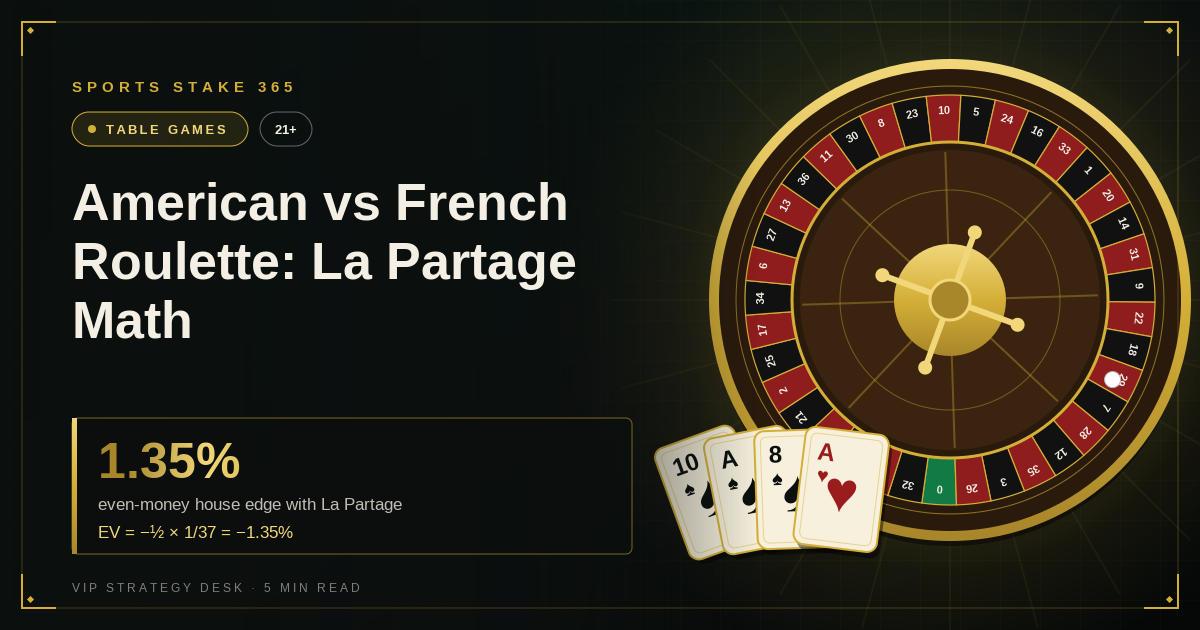
Both rules cut the house edge on even-money bets to about 1.35%, half the standard European edge. At a La Partage table, even-money bets are the cheapest way to play roulette. The rule doesn't apply to inside bets, which stay at 2.70%.
| Wheel and rule | Even-money edge | Other bets |
|---|---|---|
| American (0, 00) | 5.26% | 5.26% (top line 7.89%) |
| European (0) | 2.70% | 2.70% |
| European with La Partage / En Prison | 1.35% | 2.70% |
What It Costs Per Hour
House edge is easier to understand in dollars. A live table usually deals about 35 spins an hour. At $10 per spin, you're wagering about $350 an hour.
| Wheel | House edge | Expected loss per hour ($10 spins) | Over a 4-hour session |
|---|---|---|---|
| European + La Partage (even money) | 1.35% | $4.73 | $18.90 |
| European | 2.70% | $9.46 | $37.84 |
| American | 5.26% | $18.42 | $73.68 |
Automated and online wheels can run more than 100 spins an hour. The edge is the same, but your hourly cost roughly triples because you're betting so much more often.
Why Betting Systems Don't Work
Every few years a new roulette system goes around. All of them fail for the same reason: each spin is independent, and every bet has a negative expectation. Adding up negative-expectation bets in any order or size still gives a negative total.
The Martingale Example
The Martingale says to double your bet after every loss on an even-money bet, so one win recovers all losses plus your original stake.
Start at $10 on a European wheel:
| Losses in a row | Next bet | Total lost so far |
|---|---|---|
| 1 | $20 | $10 |
| 3 | $80 | $70 |
| 5 | $320 | $310 |
| 7 | $1,280 | $1,270 |
The chance of losing 7 even-money bets in a row on a European wheel is (19/37)^7, about 0.94%, or roughly once in every 106 sequences. That sounds rare. But each sequence only wins $10. When it fails, you've lost $1,270, and many tables have limits that stop you from placing the next $1,280 bet anyway.
Over many sequences:
0.9906 × $10 − 0.0094 × $1,270 ≈ −$2.06 per sequence
The system turns frequent small wins into rare, large losses. It doesn't change the expected cost at all.
The Gambler's Fallacy
After ten reds in a row, black feels "due." It isn't. The wheel has no memory. The chance of black on the next spin is still 18/37 on a European wheel. Scoreboards showing recent results exist because they encourage this mistake.
What You Can Actually Control
You can't beat roulette over the long run with any betting pattern. You can control how much it costs you:
- Choose a single-zero wheel every time one is available.
- Look for La Partage or En Prison and stick to even-money bets at those tables.
- Avoid the American top-line bet entirely.
- Mind the pace. Fewer spins per hour means lower hourly cost.
- Set a budget for the session and treat it as the price of entertainment.
The Bottom Line
Roulette is a fair-looking game with a fixed price. The European wheel charges you 2.7 cents per dollar wagered. The American wheel charges 5.26. Nothing you do at the table changes those numbers except choosing the wheel and the rules. If you enjoy the game, play it on the cheapest terms you can find, and treat any winning night as good luck rather than a strategy.