A craps table looks chaotic, with dozens of bets, fast action and a lot of noise. But hidden among the layout is one of the best bets in any casino: the pass line with odds. This guide works through the math so you know exactly which bets give the house a small edge and which give it a huge one.
Two Dice, 36 Outcomes
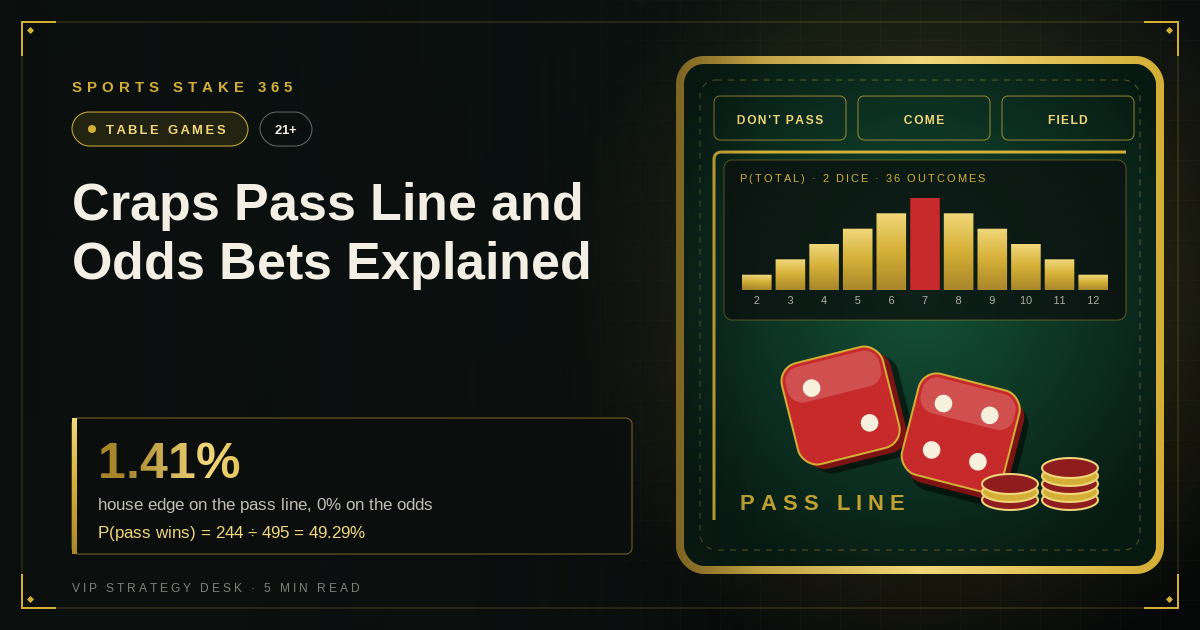
Everything in craps comes from the 36 equally likely ways two dice can land:
| Total | Ways | Probability |
|---|---|---|
| 2 | 1 | 2.78% |
| 3 | 2 | 5.56% |
| 4 | 3 | 8.33% |
| 5 | 4 | 11.11% |
| 6 | 5 | 13.89% |
| 7 | 6 | 16.67% |
| 8 | 5 | 13.89% |
| 9 | 4 | 11.11% |
| 10 | 3 | 8.33% |
| 11 | 2 | 5.56% |
| 12 | 1 | 2.78% |
Seven is the most common total, which is why it drives almost every bet on the table.
The Pass Line
The pass line is the basic bet in craps. It works in two stages.
The come-out roll:
- 7 or 11 wins immediately: 8/36, or 22.2%
- 2, 3 or 12 ("craps") loses immediately: 4/36, or 11.1%
- Any other total (4, 5, 6, 8, 9, 10) becomes the point: 24/36, or 66.7%
Once a point is set, the shooter keeps rolling. If the point comes up before a 7, you win. If a 7 comes first, you lose.
| Point | Ways to make it | Ways to roll 7 | Chance of winning |
|---|---|---|---|
| 4 or 10 | 3 | 6 | 33.3% |
| 5 or 9 | 4 | 6 | 40.0% |
| 6 or 8 | 5 | 6 | 45.5% |
Adding up every path gives the pass line's overall chance of winning:
P(win) = 244 ÷ 495 = 49.29%
The pass line pays even money, so the house edge is 50.71% − 49.29% = 1.41%.
The don't pass bet is roughly the reverse, except a 12 on the come-out is a push instead of a win. Its house edge is about 1.36%, very slightly better.
The Odds Bet: Zero House Edge
Once a point is set, you can add an odds bet behind your pass line wager. This is the only bet in a casino that pays true odds, so it carries no house edge at all.
| Point | True odds against | Odds bet pays |
|---|---|---|
| 4 or 10 | 2 to 1 | 2 to 1 |
| 5 or 9 | 3 to 2 | 3 to 2 |
| 6 or 8 | 6 to 5 | 6 to 5 |
Casinos limit how much odds you can take, usually as a multiple of your pass line bet. A common limit is 3-4-5x: three times on 4 or 10, four times on 5 or 9, and five times on 6 or 8.
How Odds Lower the Combined Edge
Because the odds bet has no edge, taking more of it spreads the pass line's edge across more money:
| Odds allowed | Combined house edge |
|---|---|
| No odds | 1.41% |
| 1x | 0.85% |
| 2x | 0.61% |
| 3-4-5x | 0.37% |
| 5x | 0.33% |
| 10x | 0.18% |
| 100x | 0.02% |
What Taking Odds Really Does
There's a subtlety here. Taking odds doesn't reduce how much you expect to lose per pass line bet. It stays at 1.41% of the pass line wager. A $10 pass line bet costs you about $0.14 on average, with or without odds.
What odds do is let you put more money in action at no extra expected cost. That increases your swings without increasing your average loss. If you want to bet more per decision, putting it into odds is far better than raising your pass line bet.
Place Bets
Place bets let you bet on a specific number to roll before a 7, without waiting for a come-out. They're popular, but they carry real edges:
| Bet | Payout | House edge |
|---|---|---|
| Place 6 or 8 | 7 to 6 | 1.52% |
| Place 5 or 9 | 7 to 5 | 4.00% |
| Place 4 or 10 | 9 to 5 | 6.67% |
| Buy 4 or 10 (5% commission on wins only) | 2 to 1 minus commission | 1.67% |
Placing the 6 and 8 is reasonable. Placing the 4 and 10 is expensive unless you buy them where commission is charged only on wins.
Proposition Bets: The Expensive Center
The center of the table holds the one-roll and hardway bets. They have attractive payouts and the worst edges in craps.
| Bet | Payout | House edge |
|---|---|---|
| Field (2 pays double, 12 pays triple) | 1 to 1 | 2.78% |
| Hard 6 or Hard 8 | 9 to 1 | 9.09% |
| Hard 4 or Hard 10 | 7 to 1 | 11.11% |
| Any craps (2, 3, 12) | 7 to 1 | 11.11% |
| Yo (11) | 15 to 1 | 11.11% |
| Aces (2) or Boxcars (12) | 30 to 1 | 13.89% |
| Any 7 | 4 to 1 | 16.67% |
Pace and Hourly Cost
A busy table might see around 100 rolls an hour, and a pass line bet takes about 3.4 rolls on average to resolve. That works out to roughly 30 pass line decisions per hour.
At $10 per pass line bet, the expected cost is around $4 an hour, whether or not you take odds. Compare that with $10 on Any 7 every roll: 100 × $10 × 16.67% = $167 an hour.
A Sound Craps Strategy
- Bet the pass line (or don't pass, if you prefer).
- Take maximum odds you're comfortable with once a point is set.
- If you want more action, use come bets with odds, which work the same way as pass line bets.
- If you place numbers, stick to the 6 and 8.
- Skip the center of the table.
No betting system changes the house edge. But in craps, choosing the right bets cuts your cost to some of the lowest levels in the casino.