Baccarat has a reputation as a high-roller's game, but its math is simple and surprisingly kind. You make no strategic decisions once your bet is placed. The only choice that matters is what you bet on, and that choice changes the house edge by more than a factor of ten.
The Three Main Bets
You can bet on Banker, Player or Tie. The hands are dealt by fixed rules, so the probabilities are known exactly. For a standard eight-deck shoe:
| Outcome | Probability | Payout | House edge |
|---|---|---|---|
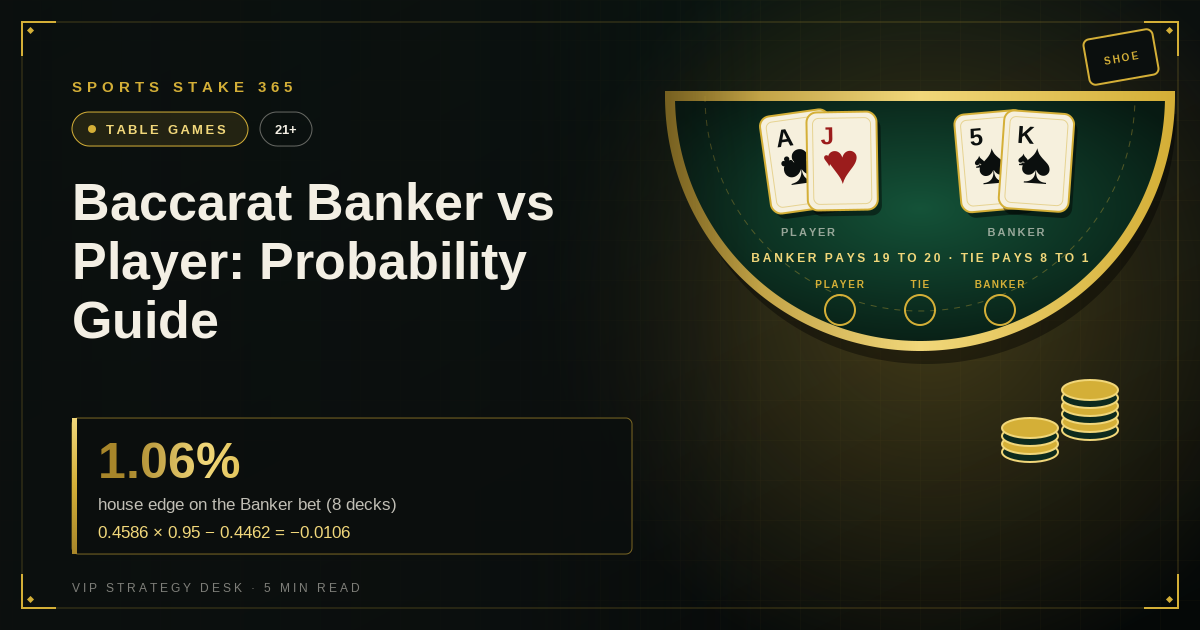
| Banker wins | 45.86% | 0.95 to 1 (5% commission) | 1.06% |
| Player wins | 44.62% | 1 to 1 | 1.24% |
| Tie | 9.52% | 8 to 1 | 14.36% |
| Tie (9 to 1 tables) | 9.52% | 9 to 1 | 4.84% |
On a Tie, Banker and Player bets push.
Why Banker Has the Edge
The Banker hand acts second and its drawing rules depend on the Player's third card. That gives it a small information advantage, so Banker wins slightly more often. To offset that, the casino takes a 5% commission on Banker wins.
The math for a $1 Banker bet:
0.4586 × $0.95 − 0.4462 × $1 = −$0.0106
Even after the commission, Banker is the best bet on the table.
Excluding Ties
If you ignore ties, Banker wins 50.68% of decided hands and Player wins 49.32%. That gap is the whole story of baccarat.
The Tie Bet Is a Trap
The Tie pays 8 to 1, which sounds generous. But ties happen only about 1 in 10.5 hands. To be a fair bet, a Tie would need to pay about 9.5 to 1. At 8 to 1, the house edge is 14.36%, more than 13 times the Banker edge.
Some tables pay 9 to 1, which cuts the edge to 4.84%. That's better, but still more than four times worse than Banker.
How the Hands Are Played
Card values: aces count 1, cards 2 to 9 count face value, and tens and face cards count 0. A hand's total is the last digit of the sum, so 7 + 8 = 15 counts as 5.
If either first two-card hand totals 8 or 9 (a "natural"), both hands stand.
Player's Rule
| Player's first two cards | Action |
|---|---|
| 0–5 | Draws a third card |
| 6–7 | Stands |
| 8–9 | Natural, stands |
Banker's Rule
If the Player stood, the Banker draws on 0–5 and stands on 6–7. If the Player drew a third card, the Banker follows this table:
| Banker total | Banker draws if Player's third card is | Banker stands if Player's third card is |
|---|---|---|
| 0–2 | Always draws | — |
| 3 | Anything except 8 | 8 |
| 4 | 2–7 | 0, 1, 8, 9 |
| 5 | 4–7 | 0–3, 8, 9 |
| 6 | 6–7 | Anything else |
| 7 | Never draws | Always stands |
You never need to memorize this. The dealer applies it automatically.
No-Commission Variants
Many tables now remove the 5% commission but change one rule to compensate.
| Variant | Rule change | Banker house edge |
|---|---|---|
| Standard | 5% commission on Banker wins | 1.06% |
| EZ Baccarat | Banker win with a three-card 7 pushes | ~1.02% |
| Super 6 / Punto Banco 6 | Banker win with a total of 6 pays 1 to 2 | ~1.46% |
EZ-style rules are about as good as standard commission. "Super 6" rules are noticeably worse, so check the felt.
Side Bets
Baccarat tables offer a growing number of side bets. Almost all of them carry much higher edges than the main bets.
| Side bet | Typical payout | Approximate house edge |
|---|---|---|
| Player Pair / Banker Pair | 11 to 1 | ~10.4% |
| Dragon 7 (EZ Baccarat) | 40 to 1 | ~7.6% |
| Panda 8 (EZ Baccarat) | 25 to 1 | ~10.2% |
Paytables vary, so these are guides rather than exact figures for every table.
Scorecards and "Roads" Don't Work
Many baccarat tables provide scorecards or display "roads" showing previous results: Big Road, Bead Plate and others. Players use them to spot streaks and patterns.
They don't predict anything. In an eight-deck shoe, removing a handful of cards shifts the probabilities by tiny amounts, nowhere near enough to overcome the house edge. Card-counting studies of baccarat have found that even perfect counting yields only rare, very small advantages, not enough to beat the game in practice.
What It Costs Per Hour
A mini-baccarat table might deal around 70 hands an hour. At $25 per hand:
| Bet | House edge | Expected loss per hour |
|---|---|---|
| Banker | 1.06% | ~$19 |
| Player | 1.24% | ~$22 |
| Tie (8 to 1) | 14.36% | ~$251 |
Session Swings and Bankroll
Baccarat's house edge is small, but its short-term swings aren't. A Banker bet has a standard deviation of about 0.93 units per hand. Over a session of 100 hands:
| Measure | Value (in betting units) |
|---|---|
| Expected result | −1.06 units |
| Standard deviation | ~9.3 units |
| Typical range (±1 SD) | about −10 to +8 units |
| Bad session (−2 SD) | about −20 units |
So the house edge costs you roughly one bet per 100 hands, while normal variance can move you 10 bets either way. That's why streaks feel so meaningful at the baccarat table, even though they're just noise.
A practical rule is to bring 20 to 30 units for a session of about 100 hands and to treat that as your maximum loss. If you're betting $25, that's $500 to $750.
Baccarat Strategy in One Paragraph
Bet Banker. If you dislike paying commission, bet Player or find an EZ-rules table. Skip the Tie and side bets. Ignore the scorecards. Set a session budget in advance. That's the complete mathematically sound strategy. Everything else is entertainment.