Every player knows what tilt is. Very few measure how much it costs them. Tilt is any emotional state that makes you play worse than you know how to. It isn't only the dramatic meltdown after a bad beat. It's also the slightly looser calls, the impatient bets and the session that runs two hours longer than planned.
This guide covers how to recognize tilt, what it costs in real numbers, and how to build habits that limit the damage.
What Tilt Actually Costs
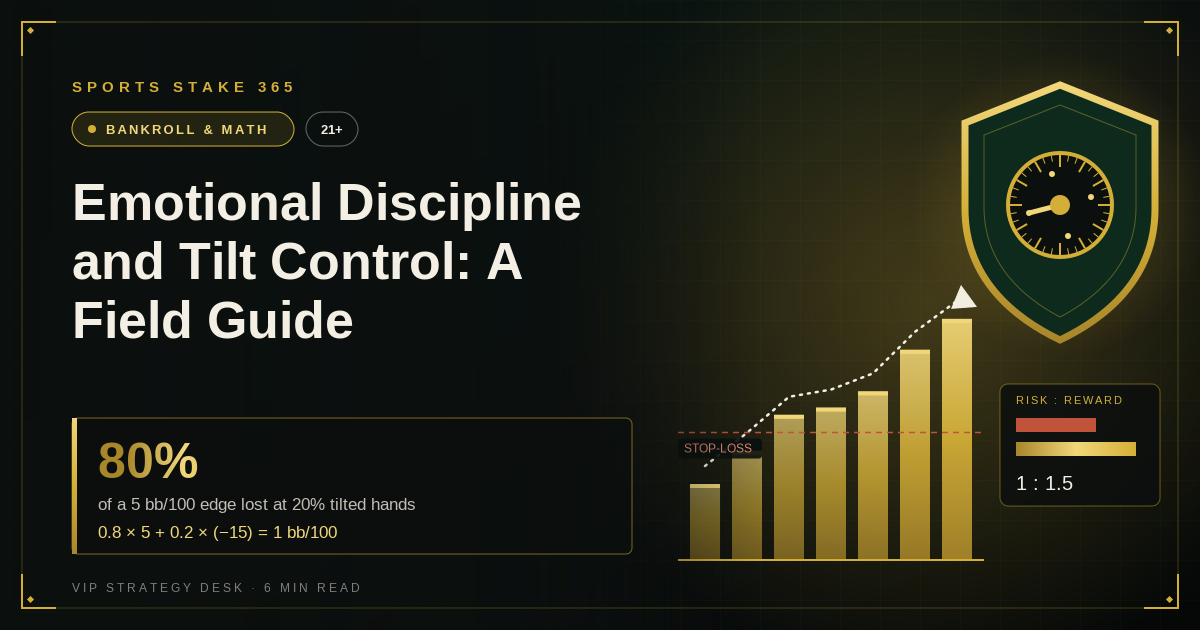
Let's put numbers on it. Imagine a player who wins 5 big blinds per 100 hands when playing well and loses 15 bb/100 when tilted. That's a realistic gap. Tilted players tend to play too many hands, call too much, and bluff into players who don't fold.
| Share of hands played on tilt | Overall win rate | Share of edge lost |
|---|---|---|
| 0% | 5.0 bb/100 | 0% |
| 10% | 3.0 bb/100 | 40% |
| 20% | 1.0 bb/100 | 80% |
| 25% | 0.0 bb/100 | 100% |
| 30% | −1.0 bb/100 | Losing player |
A player who's tilted for only one hand in four is break-even. Not because of their strategy, but because of their emotional control. Most players would find more profit by reducing tilt than by studying any new technical concept.
The same math applies to sports betting. A bettor with a 3% edge who adds one impulsive −5% bet for every two planned bets drops their expected profit from 6% of two stakes to 1%, a cut of more than 80%.
The Five Types of Tilt
Tilt isn't one thing. Recognizing your type makes it much easier to manage.
1. Injustice Tilt
Triggered by bad beats and coolers. "I got it in as a 4-to-1 favorite and lost." The feeling is that you've been cheated by luck. The fix is perspective: if you're getting your money in as a favorite, you're doing your job. The result belongs to variance.
2. Revenge Tilt
Aimed at a specific opponent. You start playing hands just to beat them, even when the spot is bad. Watch for any thought that begins with "I'm going to get this guy." When you notice it, change tables or take a break.
3. Entitlement Tilt
"I'm better than these players, so I should be winning." This leads to frustration when results don't match expectations. Being the better player only means you win over a large sample. It doesn't mean you win today.
4. Desperation Tilt
The most dangerous kind. After a big loss you start playing to get even, moving up stakes or increasing bet sizes. This is how bankrolls disappear in a single night. Any urge to get your money back today is a signal to stop.
5. Winner's Tilt
Overconfidence after a run of good results. You start playing marginal spots, moving up stakes without the bankroll, or treating a hot streak as proof of skill. It feels great, which makes it harder to notice.
Physical Warning Signs
Tilt often shows up in your body before your decisions. Learn your signs:
- Faster heartbeat or heat in the face
- Tight jaw or shoulders
- Clicking or acting faster than normal
- Replaying a previous hand in your head
- Muttering or typing in the chat
- Checking your balance more often
When you notice two or more, you're probably already tilted, even if you feel fine.
The A-Game, B-Game, C-Game Framework
A useful exercise is to write down what your game looks like at each level.
| Level | What it looks like |
|---|---|
| A-game | Patient, focused on reads, comfortable folding, notices small details |
| B-game | Solid but on autopilot, some missed reads |
| C-game | Impatient, calls "to see," bets bigger to make something happen, thinks about results |
Keep this list near your setup. When your play starts looking like the C-game column, end the session. Your C-game is where most of your losses come from, so cutting it off is one of the most profitable things you can do.
Building a Session Routine
Structure beats willpower. The players with the best emotional control usually have the most structured routines.
Before the Session
- Set a time limit and a stop-loss. Write them down.
- Check your state. Tired, hungry, stressed or upset? Skip the session.
- Do a short warm-up. Review a few hands or key notes for five minutes.
During the Session
- Take short breaks every 60 to 90 minutes.
- Use a reset after a big pot, whether you won or lost. Take three slow breaths before the next decision.
- Follow the stop-loss without exceptions. Typical limits are 3 buy-ins in poker, or 5 units in a day of sports betting.
After the Session
- Log the results and your mental state. A simple 1–10 rating is enough.
- Review one or two key hands objectively, focused on the decision, not the result.
- Don't play again the same night to make up a loss.
The Problem With Chasing Losses
Chasing losses is the most expensive kind of tilt, so it's worth looking at the math.
Suppose you normally bet 1 unit per game, and after losing 4 units you double your stake to get even. Your edge doesn't change, but your risk does. If your edge is negative or close to zero, which is true for most bettors, doubling your stakes doubles your expected losses and doubles your variance at exactly the moment your judgment is worst.
Even with a real edge, raising stakes after losses doesn't fix anything. Every bet is independent. The last four losses don't make the next bet more likely to win.
Responsible Play Comes First
Tilt control is a strategy skill, but it's also a well-being issue. Signs that gambling has become a problem include:
- Betting money you can't afford to lose
- Hiding your play from family or friends
- Feeling unable to stop, even when you want to
- Borrowing money or selling things to keep playing
- Feeling anxious or irritable when not playing
If any of these sound familiar, stop and talk to someone. In the US you can call 1-800-GAMBLER for free, confidential support. Most licensed sites also offer deposit limits, cool-off periods and self-exclusion.
The Short Version
- Measure tilt. It probably costs more than any technical leak.
- Learn your tilt type and your physical warning signs.
- Write down your A-game and C-game, and stop when you hit C.
- Use stop-losses and session limits, and follow them every time.
- Never chase losses.
- If it stops being fun, step away.
The best players aren't the ones who never feel tilt. They're the ones who notice it early and have a plan for what to do next.