Skill decides whether you're a winning player. Bankroll management decides whether you stay one long enough for it to matter. Plenty of players with a real edge have gone broke because they sized their bets as if variance didn't exist.
This guide gives you a framework: how much money you need, how much to risk at once, and what to do when things go badly.
Rule 1: Separate the Bankroll From Your Life
A bankroll is money set aside only for playing. It isn't rent, savings or an emergency fund. If losing it would change your life, it's not a bankroll.
This rule comes first because every other rule depends on it. If you can top up the roll from your paycheck whenever it drops, the math in the rest of this guide stops working, and you've lost the main defense against chasing losses.
Rule 2: Understand Risk of Ruin
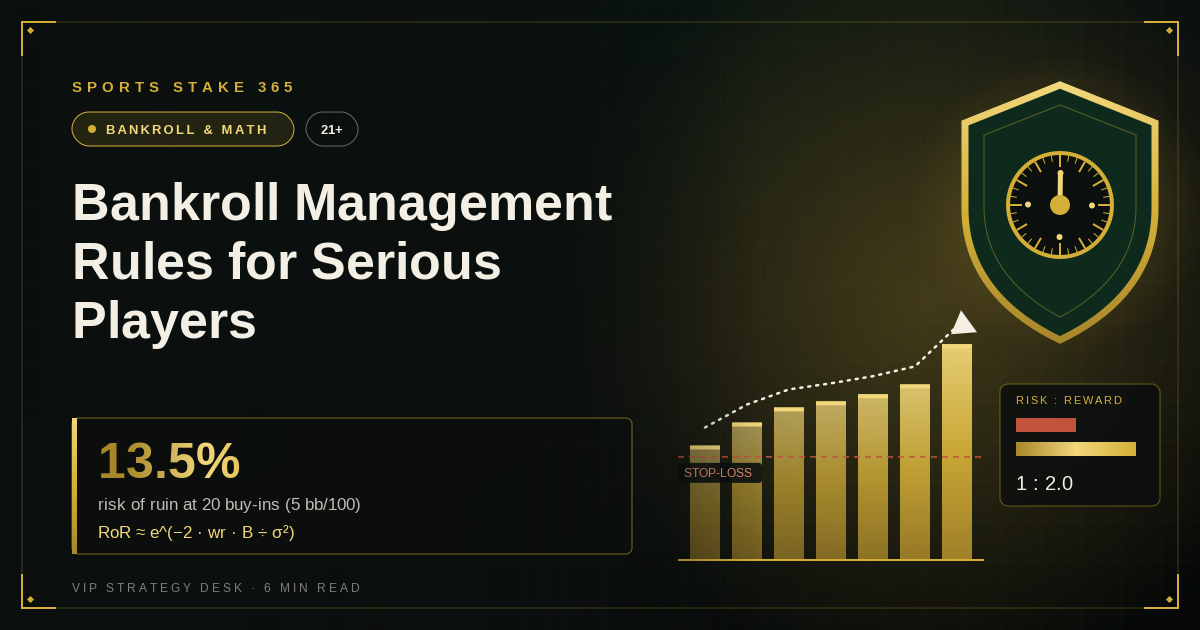
Risk of ruin is the chance your bankroll hits zero before your edge plays out. For poker cash games a widely used approximation is:
Risk of ruin ≈ e^(−2 × win rate × bankroll ÷ standard deviation²)
Take a solid no-limit player who wins 5 big blinds per 100 hands with a standard deviation of 100 bb/100, which is typical for six-handed games. With one buy-in equal to 100 big blinds:
| Bankroll (buy-ins) | Bankroll (bb) | Risk of ruin |
|---|---|---|
| 10 | 1,000 | 36.8% |
| 20 | 2,000 | 13.5% |
| 30 | 3,000 | 5.0% |
| 40 | 4,000 | 1.8% |
| 50 | 5,000 | 0.7% |
Two lessons stand out. First, a "standard" 20 buy-in roll still carries more than a 1-in-8 chance of going broke for a good player. Second, each extra 10 buy-ins cuts risk sharply. If your win rate is lower, say 2 bb/100, the 30 buy-in risk climbs to about 30%.
That's the main point. The required bankroll depends on your edge, and most players overestimate their edge.
Rule 3: Use Format-Specific Buy-In Guidelines
Variance differs across formats, so the bankroll you need differs too.
| Format | Conservative | Moderate | Aggressive |
|---|---|---|---|
| No-limit cash (6-max) | 50 buy-ins | 30 buy-ins | 20 buy-ins |
| No-limit cash (full ring) | 40 buy-ins | 25 buy-ins | 15 buy-ins |
| Sit & Go (single table) | 100 buy-ins | 60 buy-ins | 40 buy-ins |
| Multi-table tournaments | 300+ buy-ins | 150 buy-ins | 100 buy-ins |
| Sports betting (per unit) | 1% of roll | 2% of roll | 3% of roll |
Tournaments need far deeper rolls because most of your profit comes from rare deep runs. A winning tournament player can easily go 200 buy-ins without a big score.
Rule 4: Size Bets With Kelly, Then Cut It
For sports bettors the Kelly criterion gives the bet size that grows a bankroll fastest:
f = (b × p − q) ÷ b
Here f is the fraction of the bankroll to bet, b is the net decimal payout (1.0 for even money, 0.909 at −110), p is your chance of winning, and q = 1 − p.
| Bet price | Your true win probability | Full Kelly | Half Kelly | Quarter Kelly |
|---|---|---|---|---|
| +100 (even) | 53% | 6.0% | 3.0% | 1.5% |
| −110 | 54% | 3.4% | 1.7% | 0.8% |
| −110 | 55% | 5.5% | 2.7% | 1.4% |
| +150 | 42% | 3.3% | 1.7% | 0.8% |
Professionals almost never bet full Kelly. It assumes you know your exact edge, and you don't. Overestimating your edge with full Kelly leads to brutal swings. Half or quarter Kelly gives up a little growth in exchange for much smaller drawdowns, which is the right trade for almost everyone.
Rule 5: Expect the Losing Streaks
Variance doesn't feel like math when you're in it, so know what's normal before it happens.
Say you hit 55% of bets at −110 over 1,000 flat one-unit bets:
- Expected profit is about 0.05 units per bet, so +50 units.
- The standard deviation is about 0.95 units per bet, or roughly ±30 units over 1,000 bets.
- A typical result lands anywhere from +20 to +80 units. About 5% of the time a genuinely skilled bettor finishes the 1,000 bets with a loss.
- The longest losing streak you should expect in that sample is around eight bets in a row.
A 55% bettor is excellent. Even so, losing eight straight is expected over a long sample. If you'd panic and change your approach after five losses, the problem isn't your model. It's your bet size.
Rule 6: Have Clear Move-Up and Move-Down Rules
Decide in advance, in writing, when you change stakes.
- Move up when your bankroll reaches your chosen buy-in count for the next level, for example 30 buy-ins.
- Take a shot at the next level with a fixed amount, such as 3 to 5 buy-ins, and move back down if you lose it. No exceptions.
- Move down when your roll falls below about 70% of the target for your current level.
Moving down isn't failure. It's the system working as designed. The players who refuse to move down are the ones who go broke.
Rule 7: Set Session Stop-Losses
A bankroll rule covers the long run. A stop-loss covers today. Typical limits:
- Poker cash: stop after losing 3 buy-ins in a session.
- Sports betting: no more than 5 units at risk on a single day, however good the slate looks.
- Any game: stop at a fixed time, win or lose.
Stop-losses aren't about the math of a single session, since the next hand is independent of the last. They're about protecting your decision quality. After a big loss most people play worse, even if they don't feel it.
Rule 8: Track Everything
You can't manage a bankroll you don't measure. Log the date, game or market, stake, result, and a one-word note on your mental state. After a few hundred entries you'll know your actual win rate, your real variance, and which conditions make you play badly.
The Short Version
- Use money you can afford to lose, kept separate.
- Size your roll from your real edge, not the edge you hope you have.
- Use deeper rolls for higher-variance formats.
- Bet a fraction of Kelly, never more.
- Expect long losing streaks and plan for them.
- Write down your stake rules and follow them.
- Stop sessions before losses affect your judgment.
Bankroll management isn't exciting. It's simply what lets you keep playing long enough for skill to show up in your results.