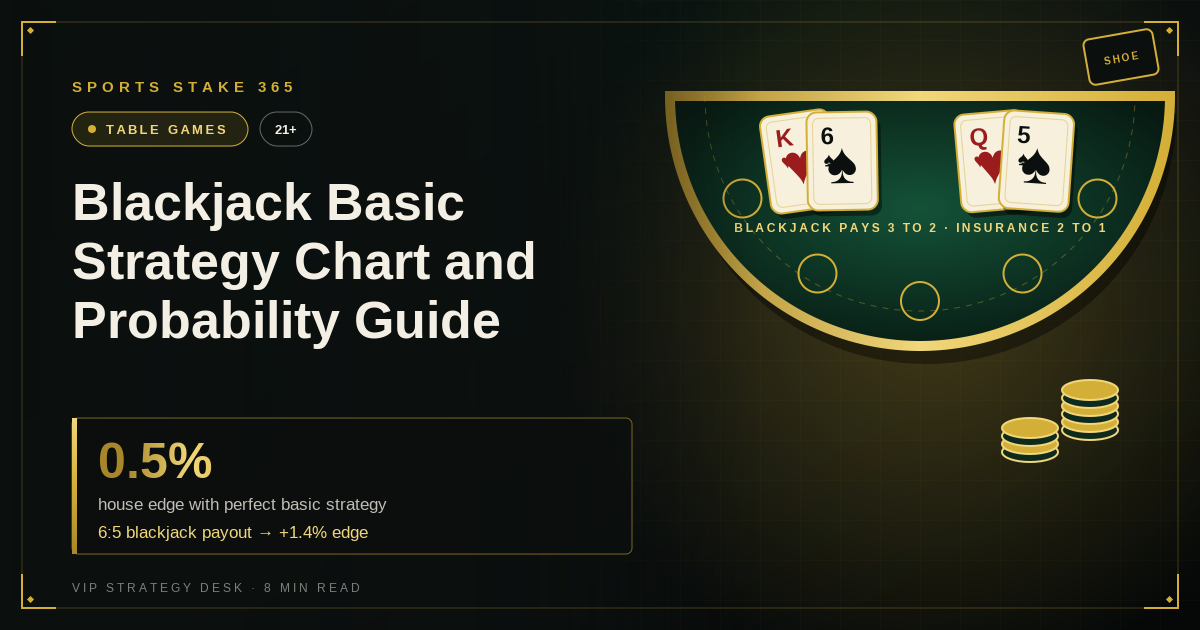
Blackjack is the rare casino game where your decisions change the house edge a lot. A player guessing on every hand might give up 2% or more. A player using perfect basic strategy in a good game gives up about 0.5%. The chart in this guide is how you close that gap.
The Rules This Chart Assumes
Basic strategy changes slightly with the rules. This chart is for the most common shoe game:
- 4 to 8 decks
- Dealer stands on soft 17 (S17)
- Double down on any first two cards
- Double after split allowed (DAS)
- Blackjack pays 3 to 2
- Dealer checks for blackjack (peeks) with an ace or ten up
Rule differences are covered at the end.
How to Read the Charts
Find your hand on the left and the dealer's upcard across the top. H = hit, S = stand, D = double if allowed (otherwise hit), Ds = double if allowed (otherwise stand), P = split.
Hard Totals
| Your hand | 2 | 3 | 4 | 5 | 6 | 7 | 8 | 9 | 10 | A |
|---|---|---|---|---|---|---|---|---|---|---|
| 8 or less | H | H | H | H | H | H | H | H | H | H |
| 9 | H | D | D | D | D | H | H | H | H | H |
| 10 | D | D | D | D | D | D | D | D | H | H |
| 11 | D | D | D | D | D | D | D | D | D | H |
| 12 | H | H | S | S | S | H | H | H | H | H |
| 13 | S | S | S | S | S | H | H | H | H | H |
| 14 | S | S | S | S | S | H | H | H | H | H |
| 15 | S | S | S | S | S | H | H | H | H | H |
| 16 | S | S | S | S | S | H | H | H | H | H |
| 17+ | S | S | S | S | S | S | S | S | S | S |
If late surrender is offered, surrender 16 against 9, 10 or ace, and 15 against 10.
Soft Totals
A soft hand includes an ace counted as 11.
| Your hand | 2 | 3 | 4 | 5 | 6 | 7 | 8 | 9 | 10 | A |
|---|---|---|---|---|---|---|---|---|---|---|
| A,2 | H | H | H | D | D | H | H | H | H | H |
| A,3 | H | H | H | D | D | H | H | H | H | H |
| A,4 | H | H | D | D | D | H | H | H | H | H |
| A,5 | H | H | D | D | D | H | H | H | H | H |
| A,6 | H | D | D | D | D | H | H | H | H | H |
| A,7 | S | Ds | Ds | Ds | Ds | S | S | H | H | H |
| A,8 | S | S | S | S | S | S | S | S | S | S |
| A,9 | S | S | S | S | S | S | S | S | S | S |
Soft 18 (A,7) is the hand most players get wrong. Standing on it against a 9, 10 or ace loses more than hitting it.
Pairs
| Your pair | 2 | 3 | 4 | 5 | 6 | 7 | 8 | 9 | 10 | A |
|---|---|---|---|---|---|---|---|---|---|---|
| A,A | P | P | P | P | P | P | P | P | P | P |
| 10,10 | S | S | S | S | S | S | S | S | S | S |
| 9,9 | P | P | P | P | P | S | P | P | S | S |
| 8,8 | P | P | P | P | P | P | P | P | P | P |
| 7,7 | P | P | P | P | P | P | H | H | H | H |
| 6,6 | P | P | P | P | P | H | H | H | H | H |
| 5,5 | D | D | D | D | D | D | D | D | H | H |
| 4,4 | H | H | H | P | P | H | H | H | H | H |
| 3,3 | P | P | P | P | P | P | H | H | H | H |
| 2,2 | P | P | P | P | P | P | H | H | H | H |
Two rules to remember: always split aces and eights, and never split fives or tens.
Why the Chart Says What It Says
Basic strategy is built from the dealer's chance of busting, which depends heavily on the upcard. Approximate figures for a six-deck, stand-on-soft-17 game:
| Dealer upcard | Chance the dealer busts |
|---|---|
| 2 | 35% |
| 3 | 37% |
| 4 | 40% |
| 5 | 42% |
| 6 | 42% |
| 7 | 26% |
| 8 | 24% |
| 9 | 23% |
| 10 | 21% |
| Ace | 12% overall (about 17% once the dealer has checked and has no blackjack) |
Against a 4, 5 or 6, the dealer busts about 40% of the time, so you avoid risking a bust yourself and you double more often. Against a 7 or higher, the dealer usually finishes with 17 or more, so a stiff hand like 15 or 16 needs to improve.
That's why 12 vs. 2 or 3 is a hit and 12 vs. 4 to 6 is a stand. Against a 2 or 3, the dealer's bust rate isn't high enough to justify standing on a total that loses to any made hand.
Insurance Is a Losing Bet
When the dealer shows an ace you'll be offered insurance, a side bet paying 2 to 1 that the dealer has blackjack.
In a shoe game, roughly 4 in 13 cards are ten-valued, about 30.8%:
EV = 0.308 × 2 − 0.692 × 1 ≈ −7.7%
Insurance costs you about 7% of the side bet, no matter what you hold. "Even money" with your own blackjack is the same bet under another name. Decline both. Card counters are the exception, since they take insurance when the remaining deck is rich in tens.
How Rules Change the House Edge
Rule changes move the house edge by more than most players realize. Approximate effects relative to the baseline game above:
| Rule | Effect on house edge |
|---|---|
| Blackjack pays 6:5 instead of 3:2 | +1.4% |
| Dealer hits soft 17 (H17) | +0.2% |
| No double after split | +0.14% |
| Late surrender allowed | −0.08% |
| Single deck (with 3:2) | −0.5% (roughly) |
The 6:5 payout is the worst. You get a blackjack in about 4.75% of hands, and each one pays 0.3 units less, so you lose about 1.4% of every bet. That turns a 0.5% game into a game close to 2%.
The Cost in Dollars
A typical table plays about 70 hands an hour. At $25 per hand:
| Game | House edge | Expected loss per hour |
|---|---|---|
| Good 3:2 game, perfect basic strategy | 0.5% | ~$8.75 |
| Same game with common mistakes | 2.0% | ~$35 |
| 6:5 game, perfect basic strategy | 1.9% | ~$33 |
Good strategy and good rules together cut your hourly cost by about 75%.
Practice Tips
- Learn the hard totals first. They come up most often.
- Memorize the pairs chart in short sessions.
- Use free trainer apps until you can answer instantly.
- Most casinos allow a printed strategy card at the table, so bring one.
- Read the felt before you sit. If it says "Blackjack pays 6 to 5," find another table.
Basic strategy won't make blackjack a winning game on its own. It does make it one of the best deals in the casino, and that's worth learning.