Every slot has two numbers that matter more than its theme, its bonus game or its sound design. The first is RTP, which tells you what the game costs on average. The second is volatility, which tells you how that cost shows up: as a slow drip or in long dry spells broken by big hits. This guide explains both with real arithmetic.
What RTP Actually Means
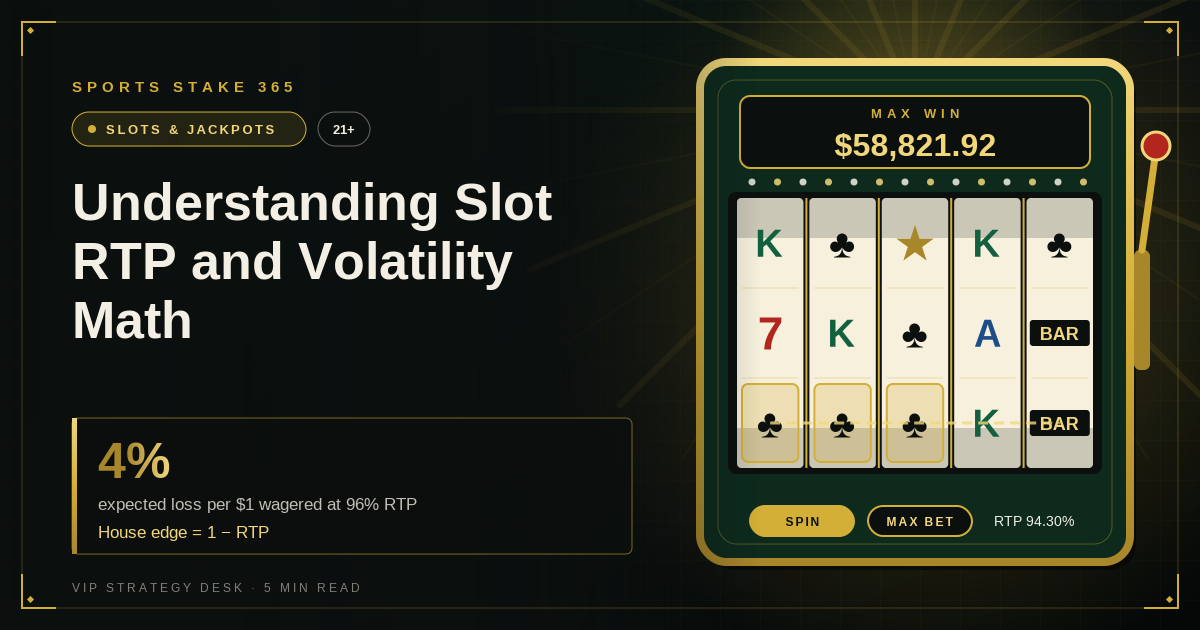
Return to player (RTP) is the share of all money wagered that a slot pays back over its lifetime. A game with a 96% RTP returns $96 for every $100 wagered, on average, across millions of spins.
The house edge is simply what's left:
House edge = 1 − RTP
So a 96% slot carries a 4% house edge. That figure applies to every dollar you wager, not to the money you bring. That distinction is where most players go wrong.
RTP Is Charged on Turnover, Not Deposits
If you deposit $100 and keep re-betting your winnings, you might wager $1,000 or more before your balance runs out. The 4% applies to that whole $1,000. This is why a session of quick spins can cost much more than the headline RTP suggests.
The Hourly Cost of Different RTPs
Online slots typically run at around 500 to 600 spins an hour if you play steadily. Here's the expected cost at $1 per spin and 600 spins per hour:
| RTP | House edge | Expected loss per hour | Expected loss per 1,000 spins |
|---|---|---|---|
| 98% | 2% | $12 | $20 |
| 97% | 3% | $18 | $30 |
| 96% | 4% | $24 | $40 |
| 94% | 6% | $36 | $60 |
| 92% | 8% | $48 | $80 |
| 88% | 12% | $72 | $120 |
Two points of RTP don't sound like much. But the difference between a 96% game and a 92% game doubles your expected cost.
Same Game, Different RTP
Many slot providers release one game in several RTP versions, such as 96%, 94%, 92% and 88%. The operator picks which one to offer. The artwork, features and maximum win are identical. Only the math changes.
That means the same title can cost very different amounts at different sites. Most regulated markets require the RTP to be shown in the game's info or help screen. Check it before you play. If it isn't listed, treat that as a warning sign.
Volatility: The Shape of the Payouts
Two games can have identical RTPs and feel completely different. Volatility, sometimes called variance, describes how the returns are distributed.
- Low volatility: frequent small wins, rare big ones. Your balance moves slowly.
- High volatility: long runs of losing spins, with a small number of large wins carrying most of the RTP.
A Worked Example
Imagine two simplified games, both at 96% RTP, with a $1 bet:
- Game A: pays 2× your bet with 48% probability, otherwise nothing.
- Game B: pays 100× your bet with 0.96% probability, otherwise nothing.
Both return $0.96 per spin on average. But their standard deviations are very different:
| Game A | Game B | |
|---|---|---|
| RTP | 96% | 96% |
| Hit frequency | 48% | 0.96% (about 1 in 104) |
| Standard deviation per spin | ~1.0 | ~9.75 |
| Expected result after 500 spins | −$20 | −$20 |
| Standard deviation after 500 spins | ~$22 | ~$218 |
Now look at what 500 spins actually produce:
| Outcome after 500 spins | Game A | Game B |
|---|---|---|
| Finish ahead | ~17% | ~35% |
| Lose $300 or more | ~0% | ~14% |
| Lose all $500 | ~0% | ~0.8% |
That's the volatility trade-off. The high-volatility game gives you a better chance of finishing ahead in a short session, because a few hits can carry you. It also gives you a much higher chance of a heavy loss. The average cost is exactly the same.
Hit Frequency Isn't Win Frequency
Many slots publish a hit frequency, often somewhere around 20% to 35%. That's the share of spins that return anything at all. It isn't the share of spins that make a profit.
On modern multi-line games, a large share of "wins" pay back less than your stake. Bet $1, win $0.40, and the game celebrates while you've lost $0.60. Treat hit frequency as a measure of how lively a game feels, not how profitable it is.
Where the RTP Comes From
In most feature-heavy slots, the base game returns only part of the RTP. Free spins, bonus rounds and multipliers make up the rest. It's common for bonus features to account for a third or more of a game's total return.
That has two consequences:
- Your results depend heavily on whether you trigger the bonus. Sessions without it usually run well below the advertised RTP.
- Games with rare, rich bonuses behave like high-volatility games even if their base game feels steady.
RTP Is a Long-Run Number
A 96% RTP is measured over millions of spins. A single session of a few hundred spins can land anywhere. Expect your actual return in any one session to swing widely around the RTP, especially on high-volatility games.
This also means nothing you do changes RTP. Slot outcomes come from a random number generator. Stopping and restarting, changing the bet timing or switching machines doesn't affect the odds of the next spin.
How to Use This
- Check the RTP in the info screen and prefer the highest version available.
- Match volatility to your budget. High volatility needs a bigger bankroll relative to bet size. A common guideline is 200 or more bets for high-volatility games.
- Control your turnover. Fewer spins per hour and smaller bets lower your hourly cost directly.
- Set a loss limit and a time limit before you start, and stick to them.
- Treat slots as paid entertainment. At any RTP below 100%, the expected result is a loss.
Understanding RTP and volatility won't change the math of any slot. It will tell you exactly what you're paying for, and that's the most useful thing a player can know.