A progressive jackpot is the most eye-catching number in any casino. It climbs in real time, sometimes into eight or nine figures. But that jackpot isn't free money. Every player who doesn't win it pays for it, through a slightly lower return on every spin. This guide explains where the money comes from and when, if ever, the math tilts.
How Progressives Are Funded
A progressive slot takes a small share of every bet, often around 1% to 3%, and adds it to the jackpot meter. When someone hits the jackpot, it resets to a starting value called the seed, and the cycle starts again.
To pay for that contribution, the base game's RTP is set lower than a comparable fixed-payout slot. A typical structure might look like this:
| Component | Fixed-payout slot | Progressive slot |
|---|---|---|
| Base game return | 96% | 88% |
| Jackpot contribution | none | ~2% of each bet |
| Return from jackpot (at seed) | n/a | varies with meter |
| Advertised total RTP | 96% | often quoted as a range |
The key point: on the progressive, most of your return comes from the base game, and the base game is stingier. You're paying for a lottery ticket on every spin.
Three Types of Jackpot
- Standalone progressive: one machine, one meter.
- Local (linked) progressive: several machines in one casino share a meter.
- Wide-area progressive: machines across many casinos or sites feed one meter. These produce the giant jackpots, and they're the hardest to win.
When Does the Jackpot Make RTP Rise?
The jackpot's contribution to RTP depends on its size. As the meter grows, the expected value of each spin grows too.
Let's use a simplified example:
- Base game RTP: 88%
- Max bet: $3 (required to qualify)
- Chance of hitting the jackpot: 1 in 50,000,000 per spin
- Jackpot meter: J
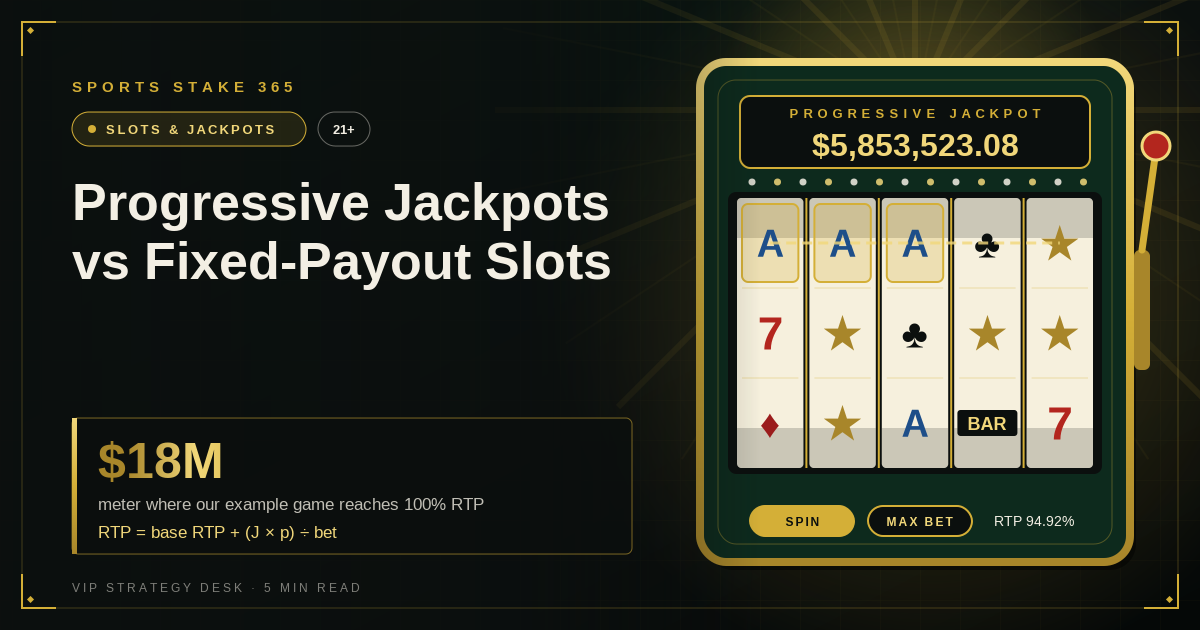
The jackpot's contribution to RTP is J × p ÷ bet:
J ÷ (50,000,000 × $3) = J ÷ $150,000,000
| Jackpot meter | Jackpot share of RTP | Total RTP |
|---|---|---|
| $5,000,000 | 3.3% | 91.3% |
| $10,000,000 | 6.7% | 94.7% |
| $15,000,000 | 10.0% | 98.0% |
| $18,000,000 | 12.0% | 100.0% |
| $25,000,000 | 16.7% | 104.7% |
On paper, this game becomes a positive-expectation bet once the meter passes $18 million.
Why It's Rarely That Simple
That paper number ignores three things that matter a lot:
- Annuity versus lump sum. Many large jackpots advertise the total of annual payments. Taking cash upfront might pay roughly half of the headline figure.
- Taxes. In many countries, large wins are taxed heavily.
- Shared or split wins, depending on the game's rules.
Adjust for a 55% lump-sum value and a 37% tax rate, and the break-even meter changes dramatically:
$18,000,000 ÷ (0.55 × 0.63) ≈ $52 million
So a jackpot that looks "overdue" at $25 million is still costing you money on every spin.
Fixed-Payout Slots
A fixed-payout slot has a top prize that never changes, such as 5,000× or 10,000× your bet. Because none of your stake is diverted to a meter, these games can offer a higher base RTP.
| Feature | Fixed-payout | Progressive |
|---|---|---|
| Top prize | Fixed multiple of bet | Grows until won |
| Base game RTP | Usually higher | Usually lower |
| Volatility | Medium to high | Very high |
| Odds of top prize | Published or estimable | Often very long |
| Best for | Longer sessions | Players chasing a life-changing win |
If you want more playing time from the same budget, fixed-payout games are almost always the better choice.
Must-Hit-By Jackpots
Some casinos offer must-hit-by (or mystery) progressives. The jackpot is guaranteed to drop before it reaches a stated cap, for example "must hit by $500."
The trigger point is set randomly between the seed and the cap. As the meter approaches the cap, the jackpot becomes more likely to land on any given spin.
Example: a mini jackpot resets at $250 and must hit by $500. The meter grows by 1% of all coin-in.
- At $480, it must drop within the next $20 of meter growth.
- That's $2,000 of total coin-in across everyone playing the bank.
- If the trigger point is evenly spread, you'd expect it within about $1,000 of coin-in.
If you were the only player and the base game had a 10% house edge, your expected cost of about $1,000 in wagers would be around $100, for a near-certain shot at a $490 prize. That's a strong bet.
But in practice:
- You're rarely the only player. Others crowd these machines near the cap.
- Your chance of being the one who triggers it falls with each extra player.
- Casinos design these games with all of this in mind.
The opportunity is real but narrow. It only works when the meter is close to the cap and you're competing with few other players.
How to Choose
- Decide what you want. A long session favors fixed-payout games. A small shot at a giant prize favors progressives.
- Check whether you must bet max to qualify for the jackpot. Playing a progressive below the qualifying bet means paying for the jackpot without being eligible to win it.
- Don't chase "overdue" jackpots. Each spin is independent. A large meter only means the jackpot is worth more, not that it's more likely to hit.
- Account for taxes and payment structure before believing any break-even calculation.
- Set a budget for jackpot play separate from your other gaming money.
Progressive jackpots sell a dream, and the price of that dream is a lower return on every spin. Knowing the math lets you decide whether the trade is worth it to you.