A betting line is a price, and prices move when new information or new money arrives. Learning to read those moves won't tell you who'll win. It will tell you how the market is changing its mind, and that's often more useful.
Why Lines Move
Lines move for four main reasons:
- Information. Injuries, lineup news, weather, rest and travel. In the NBA, a star being ruled out can move a spread several points within minutes.
- Respected money. Sportsbooks track which accounts have historically beaten the closing number. A bet from one of those accounts can move a line more than many recreational bets combined.
- Balancing liability. If a book has too much exposure on one side, it may shade the price to draw money to the other side.
- Copying the market. Many books follow a few market-making books. When those books move, others follow quickly.
The first two carry information. The last two mostly don't. Your job is to tell them apart.
Converting Prices to Probabilities
You can't read movement without converting odds into implied probability.
- Negative American odds: probability = odds ÷ (odds + 100), using the absolute value. −150 → 150 ÷ 250 = 60.0%
- Positive American odds: probability = 100 ÷ (odds + 100). +130 → 100 ÷ 230 = 43.5%
- Decimal odds: probability = 1 ÷ decimal. 2.50 → 40.0%
Those two prices add up to 103.5%. The extra 3.5% is the bookmaker's margin, often called the vig or overround. To get a fair estimate, divide each by the total:
| Side | Price | Implied | No-vig fair |
|---|---|---|---|
| Favorite | −150 | 60.0% | 58.0% |
| Underdog | +130 | 43.5% | 42.0% |
| Total | 103.5% | 100% |
Now a move from −150 to −170 means something specific. The market's no-vig estimate went from about 58% to about 61%.
Steam Moves
A steam move is a sudden, sharp move across many books at once, usually triggered by heavy betting from respected groups. A Premier League match might go from Arsenal −0.75 to −1.0 on the Asian handicap within a few minutes across the market.
What steam tells you:
- Someone the market respects has an opinion.
- The new number is usually more accurate than the old one.
What it doesn't tell you is that chasing it pays. By the time you see a steam move on a screen, the value is mostly gone. Chasing steam at worse prices is one of the most common ways bettors give back their edge.
Reverse Line Movement
Reverse line movement happens when a line moves against the side taking most of the bets. Say 75% of tickets are on the favorite, yet the spread drops from −6.5 to −5.5.
The usual explanation is that a smaller number of larger, sharper bets are on the underdog. The book cares more about where respected money is than about ticket counts.
Be careful with it, though:
- Public betting percentages from most sources are estimates, and they're often unreliable.
- Ticket share and money share are different. 75% of tickets might be only 40% of the money.
- Reverse movement is well known now, so the edge from following it has shrunk.
Treat it as a reason to look closer, not as a signal to bet.
Key Numbers in the NFL
In American football, scoring comes mostly in threes and sevens, so final margins cluster on certain numbers. Historically, about 15% of NFL games have been decided by exactly 3 points and roughly 9% by exactly 7. Margins of 6, 10, 4 and 14 also show up more often than nearby numbers.
| Spread move | Approx. value |
|---|---|
| 2.5 → 3 or 3 → 3.5 | Very high |
| 6.5 → 7 or 7 → 7.5 | High |
| 9.5 → 10 or 3.5 → 4 | Moderate |
| 4.5 → 5 or 11.5 → 12 | Low |
A move from −2.5 to −3 is very different from a move from −4.5 to −5. When a line crosses a key number, the market has changed its view a lot, and getting the better side of a key number is worth more than almost any other half point. Recent rule changes, including kickoff and extra-point rules, have slightly changed how often these margins occur, so check current data rather than relying on old charts.
Basketball has no strong key numbers because scoring is frequent and varied. Football (soccer) markets work differently: Asian handicaps and goal totals move in quarter-goal steps, and the jump from 2.5 to 2.75 goals on a total matters because of how often matches end with exactly three goals.
Closing Line Value: The Best Measure of Skill
The closing line is the last price before the game starts. By then, all public information and most sharp money is priced in. In efficient markets, the closing line is the best available estimate of the true probability.
Closing line value (CLV) compares the price you got with that closing number.
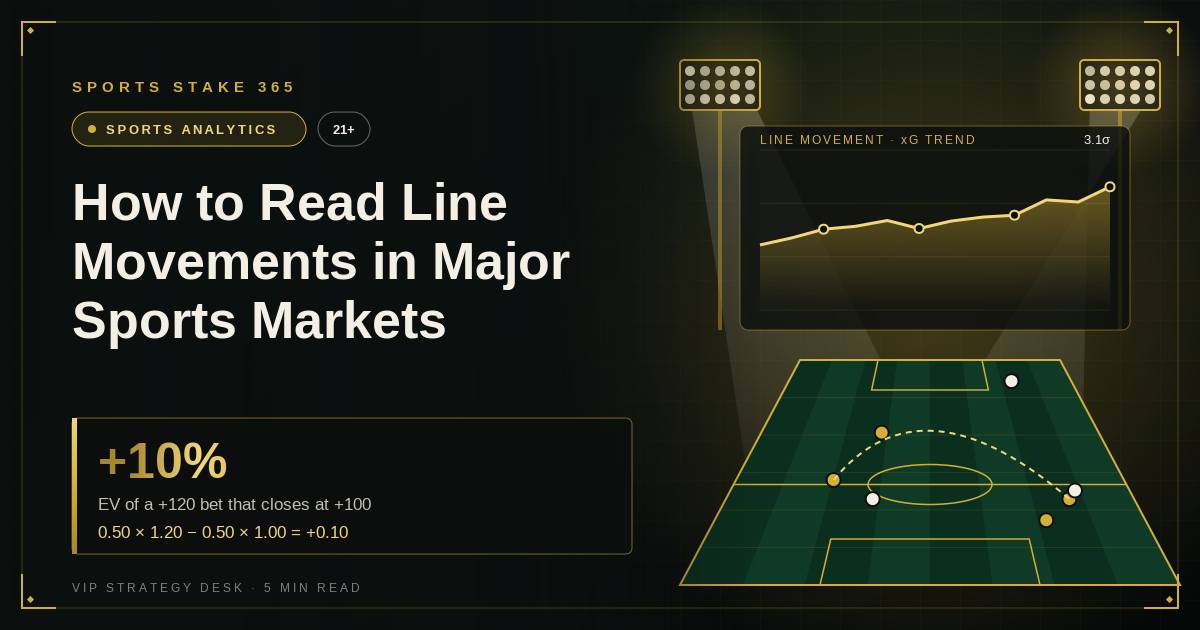
Example: you bet a team at +120 (45.5% implied). It closes at +100, which is about 50% after removing the vig. If 50% is the true chance, your bet's expected value is:
0.50 × 1.20 − 0.50 × 1.00 = +0.10, or +10% of your stake
You can't know whether one bet was good from its result. But if you beat the closing line consistently across hundreds of bets, that's strong evidence of a real edge. It's also much faster to measure than profit, because results are noisy and CLV isn't.
A Practical Line-Reading Routine
- Record the opener and the current price for every market you follow.
- Convert to no-vig probability so moves are comparable across sports and prices.
- Find the cause. Check injury reports, lineup news and weather before assuming the move came from sharp money.
- Note key numbers in football and totals markets.
- Track your CLV on every bet, not just the wins.
- Don't chase. If the value is gone, let the bet go.
The Bottom Line
Line movement is the market thinking out loud. Read it to understand what other informed bettors believe and why. Don't treat it as a tip sheet. The bettors who last aren't the ones who follow every move. They're the ones who regularly get a better number than the market ends up at.